
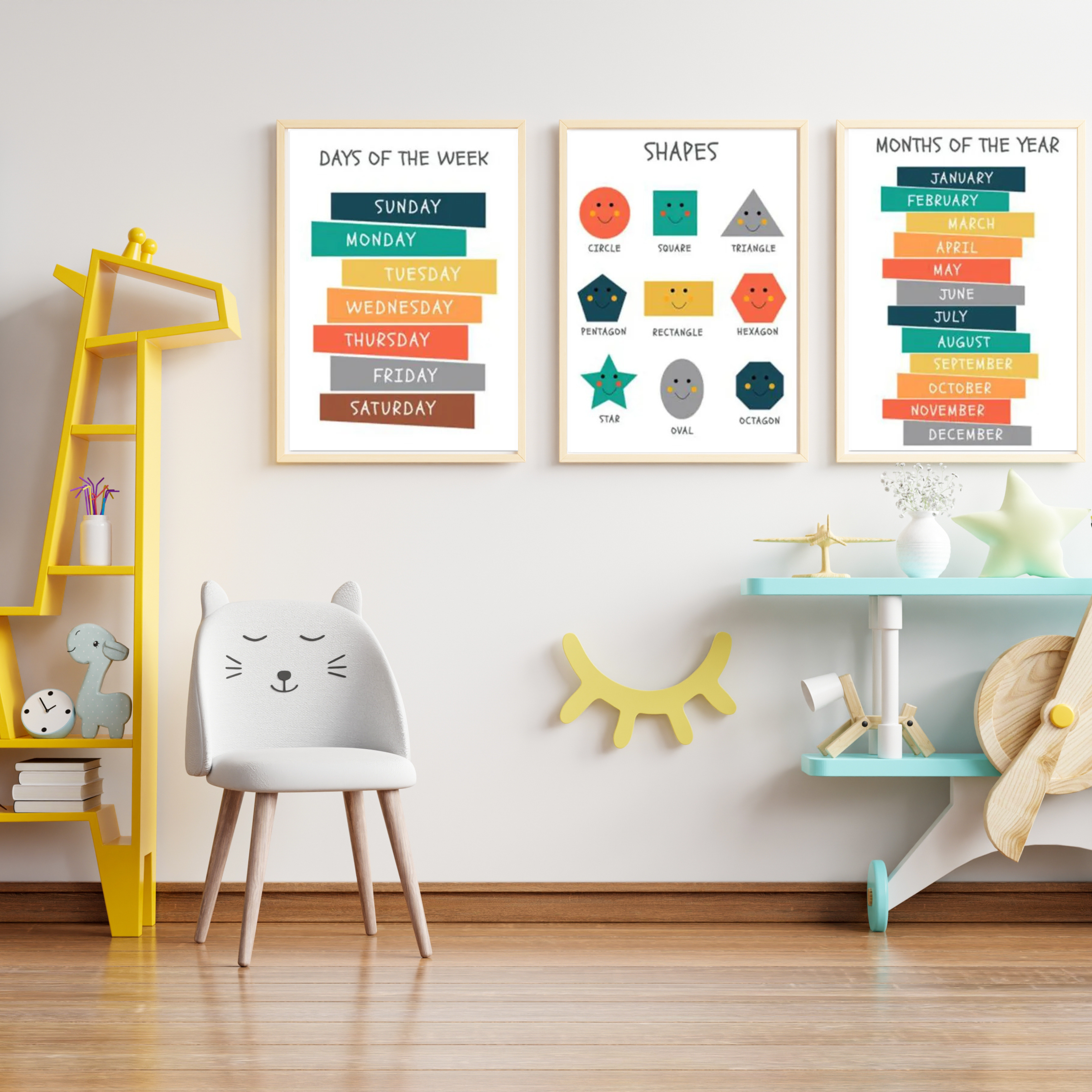
Learning foreign languages is a valuable opportunity for children. The earlier they start, the more easily they assimilate sounds, vocabulary, and grammar.
But how can we make this learning natural, fun and effective ? Bilingual posters are an excellent tool to stimulate visual learning and integrate a foreign language into everyday life.
Discover how bilingual educational posters can facilitate language learning and how to best use them!
1. Why learn a foreign language from a young age?
1.1 A brain more receptive to languages
🧠 Before the age of 6, children's brains are particularly flexible and receptive to new sounds and linguistic structures. They can assimilate several languages effortlessly .
💡 Interesting fact : A Harvard University study shows that children exposed to two languages before age 5 have better cognitive adaptability.
1.2 Cognitive and academic benefits
✔ Improves memory and concentration .
3. How to choose the right bilingual poster for your child?
3.1 Opt for a clear and colorful poster
🌈 An attractive design with bright colors and engaging illustrations stimulates interest and facilitates understanding .
3.2 Associating images and words to reinforce memorization
📖 A poster with precise illustrations helps the child to better assimilate the vocabulary .
💡 Example : Instead of a simple word "Dog / Chien", an image of a dog reinforces the mental connection between the word and its meaning.
3.3 Choose a poster that adapts to different age groups
👶 For little ones (2-3 years old) : Simple posters with colors, animals, the alphabet .
🧒 From 4-6 years old : More detailed posters with the days of the week, numbers, emotions .
👦 From age 7 : Posters with common phrases and simple expressions .
💡 On Nookido.com , we offer personalized bilingual posters , adapted to each age and learning level.
4. Where should a bilingual poster be placed for optimal learning?
📌 In the bedroom : Near the bed or desk for daily exposure .
📌 In the bathroom : Learn body words and routines (e.g., "Wash your hands / Wash your hands").
📌 In the play area : Associate learning with pleasant and natural moments.
💡 Tip : Alternate the posters every 3 to 6 months to maintain interest and enrich vocabulary.
5. How to use a bilingual poster in an interactive way?
5.1 Turning learning into play
🎲 Fun activity ideas:
✔ The hidden word game : Hide a word on the poster and ask the child to guess which one is missing.
✔ Match real objects to the words on the poster : "Can you show me a blue object like the one on the poster?"
✔ Read aloud : Have the words repeated several times in both languages.
💡 Tip : Vary the activities to avoid routine and maintain the child's engagement.
6. Supplement learning with other methods
📚 Bilingual books : Stories with text in French and English.
🎵 Songs in a foreign language : Stimulates auditory memory.
📱 Educational applications : To combine interactive play and learning .
💡 Tip : Mixing visual (posters), auditory (songs) and interactive (games) learning is the best approach to learning a language effectively.
FAQ – Frequently Asked Questions from Parents
At what age should you start learning a foreign language?
From 6 months old , babies recognize the sounds of different languages . At 2-3 years old , they can learn their first foreign words and at 4-5 years old , they easily assimilate bilingual vocabulary.
My child is not interested in languages, what should I do?
✔ Use fun materials such as colorful posters, games and songs.
✔ Set an example : Speak with him in the foreign language, integrating it into his daily life.
Are bilingual posters enough to learn a language?
No, they must be complemented by other media (listening, games, discussions) for balanced learning.
Key takeaways
Bilingual posters are a powerful tool for learning a foreign language from a young age. They allow for continuous exposure , facilitate memorization, and make learning fun and effective .
🌍 Integrate a bilingual poster into your child's daily life and discover our personalized models on Nookido.com !
✔ Strengthens reading and math skills .
✔ Makes learning other languages easier later on.
1.3 A cultural and social openness
🌍 Learning a new language allows you to discover other cultures , and promotes open-mindedness.
💡 Example : A child who learns English or Spanish from a young age will find it easier to communicate and travel as an adult.
2. Why use bilingual posters to learn a language?
2.1 Effective visual learning
📌 Bilingual posters allow for continuous exposure to key words and phrases. Children assimilate new words effortlessly , simply by seeing them regularly.
2.2 A natural and intuitive method
🎨 Associating a word with an image and its translation helps with rapid memorization.
💡 Example : A poster with "Chat / Cat" + an illustration of a cat allows the child to memorize the word in French and English naturally .
2.3 Support accessible at all times
🔠 Unlike books or apps, a bilingual poster is always visible , which facilitates recurrence and passive learning .
💡 Interesting fact : Research shows that children who are exposed to a foreign language daily can learn up to 500 words in a year without conscious effort .





Share and get 15% off!
Simply share this product on one of the following social networks and you will unlock 15% off!