
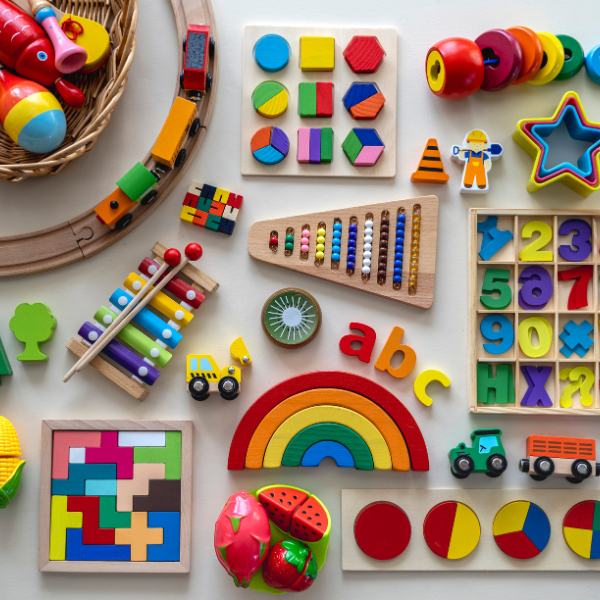
Learning about colors and shapes is an essential step in children's development. From a very young age, they are attracted to bright colors and varied shapes.
But how can we help them memorize and recognize these elements while having fun? Discover playful methods, games, and practical tips to support your child in this fundamental learning.
1. At what age does a child begin to recognize colors and shapes?
📌 Between 6 and 12 months : Babies begin to differentiate colors but do not yet know how to name them.
📌 Around 18 months to 2 years : They show preferences for certain colors and begin to recognize simple shapes (circle, square).
📌 Between 2 and 3 years old : They can name the basic colors (red, blue, yellow) and identify different shapes.
📌 From 3-4 years old : They learn to associate colors and shapes with everyday objects and can classify them.
💡 Tip : Every child develops at their own pace. The important thing is to stimulate learning without pressure and in a fun environment.
2. Why is learning about colors and shapes important?
2.1 It promotes language development
🎨 Learning to name colors and shapes enriches a child's vocabulary and improves their communication.
2.2 It stimulates visual perception
👀 Colors help to identify and differentiate objects , while shapes help to understand spatial concepts .
2.3 It prepares students for the basics of mathematics and reading
🔢 Shapes are the first geometric concepts that a child assimilates before learning numbers and letters.
💡 Example : Understanding the difference between a circle and a square helps the child to distinguish the letters O and D , or the numbers 6 and 9 .
3. How to learn colors and shapes in a fun way?
3.1 Integrating colours and shapes into everyday life
🛍 Point out the colored objects while talking to your child:
- "Look at this red apple!"
- "Take your blue balloon."
📦 Ask him to sort the objects :
- Arrange the toys by color.
- Classify the shapes by size and type.
💡 Tip : Take advantage of everyday activities (shopping, dressing, cooking) to have him observe and name the colors.
3.2 Use educational posters
🖼 A poster of colours and shapes placed in his room or play area facilitates memorization .
✔ Where to place them?
📍 On a wall near his desk or play area.
📍 At eye level so he can easily observe them.
💡 On Nookido.com , we offer personalized educational posters that combine decoration and fun learning .
3.3 Learning through games and creative activities
🎲 Some game ideas :
✔ Sorting game : ask him to group the objects of the same color .
✔ Color Hunt : "Can you find me a green object in the room?"
✔ Modeling clay : create different colorful shapes.
✔ Painting and coloring : to associate color and word more easily.
✔ Construction games : sort the LEGO bricks by shape and color.
3.4 Read books about colours and shapes
📚 Picture books help children associate colours and shapes with real objects .
✔ Choose interactive books where the child has to point or touch the colors and shapes .
✔ Sound books are also very effective for multisensory learning.
💡 Example of a suitable book : "My First Picture Book of Colors and Shapes" .
3.5 Playing with light and shadows
🔦 Use a flashlight to project shapes onto the wall and ask your child to guess what they are .
🌈 Use a prism to show how light splits into multiple colors.
4. How to adapt learning according to age?
| Age | Adapted activity |
|---|---|
| 6-12 months | Display colorful and contrasting objects |
| 12-18 months | Reading colorful books, pointing out colors |
| 2-3 years | Sorting games by color and shape, educational posters |
| 3-4 years | Painting, puzzles, learning to name colors |
| 4-5 years | Matching color and shape to real objects, more complex games |
💡 Tip : Be gradual ! Don't introduce all the colours and shapes at once, start with the simplest ones and gradually add the others.
5. Why choose a personalized educational poster?
🖼 A personalized poster with the child's name motivates them to learn more easily.
📌 The advantages :
✔ Constant visual support that allows for passive learning.
✔ A fun and educational decoration for their room.
✔ An original and useful gift for a child who is in the midst of discovery.
💡 Discover our educational posters on Nookido.com , adapted to every age and every world!
FAQ – Frequently Asked Questions from Parents
At what age should a child know how to name the colors?
Around the age of 2 , he begins to recognize colors, and between 3 and 4 years old , he can name them with more precision.
What should I do if my child is still confusing colors at age 4?
This is perfectly normal ; every child progresses at their own pace. Continue to show them colors with real objects and practice with games.
Are posters really effective?
Yes! Visual aids allow the child to see colors and shapes daily , which strengthens their memory and natural learning.
Key takeaways
Learning about colors and shapes should be progressive, fun, and interactive . With educational posters, games, and age-appropriate books , children can learn while having fun throughout the day .
🎨 Discover our personalized educational posters on Nookido.com and support your child in their playful learning!





Share and get 15% off!
Simply share this product on one of the following social networks and you will unlock 15% off!