
Starting school is a big step for children! To prepare them well, it is essential to develop their cognitive, motor and social skills from a very young age.
Educational games are an excellent way to learn while having fun , while also boosting their self-confidence and independence.
In this article, discover the best educational games to help your child prepare for school while having fun !
1. Why are educational games essential before starting school?
1.1 They develop essential skills
📖 Language and communication : Word and story games to enrich vocabulary.
🧮 Logic and mathematics : Number and logic games to understand the basics of math.
🎨 Creativity and motor skills : Manual activities to develop coordination and imagination.
1.2 They enhance concentration and patience
⏳ Learning to follow rules and stay attentive is a major asset for school .
1.3 They promote autonomy and self-confidence
👦 A child who plays alone or in a group learns to make decisions and solve problems .
💡 Interesting fact : A study from the University of Cambridge showed that children who regularly play educational games develop 25% better problem-solving skills than those who do not.
2. Educational games for learning basic school skills
2.1 Games for learning the alphabet and letters
🔠 Alphabet puzzles : Ideal for associating letters and sounds .
📖 Magnetic letters : Helps to form first words on the fridge or a slate.
🎲 Mystery Word Game : Guess a word from a few letters.
💡 Tip : An educational alphabet poster placed in the child's room facilitates memorization .
2.2 Games for learning to count and discovering numbers
🔢 Number Dominoes : Match numbers to quantities.
🧩 Number puzzles : Match a quantity of objects to a number.
💰 Shopkeeper game : Learn to count by simulating a purchase.
💡 Tip : Use educational posters with colorful and illustrated numbers to reinforce learning .
2.3 Games to enrich vocabulary and communication
🎭 Mime game : Guess words from a mime.
📚 Illustrated story games : Tell a story based on pictures.
🔄 "Who am I?" game : Describe an object or animal to make others guess what it is.
💡 Tip : Reading interactive books allows you to learn new words while stimulating your imagination.
3. Games to develop motor skills and creativity
3.1 Games to improve fine motor skills
✍ Coloring and tracing : Learning to hold a pencil correctly.
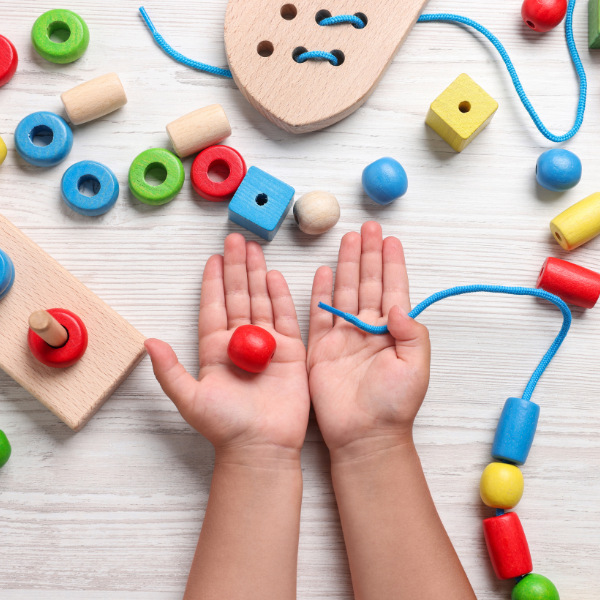
🧩 Bead threading games : Improves hand-eye coordination.
✂ Cutting and pasting : Practices precision and patience.
💡 Tip : Encouraging children to draw letters and numbers helps prepare their handwriting for school.
3.2 Creative and artistic games
🎨 Painting and modeling : Develops artistic expression.
🎭 Puppets and theatre : Stimulates imagination and public speaking.
🎶 Songs and nursery rhymes : Helps to memorize sounds and rhythms.
💡 Tip : Combining music and movement helps strengthen auditory memory and motor development.
4. Games for learning logic and problem-solving
🎲 Progressive puzzles : Encourages thinking and patience.
🧩 Matching games : Matching similar objects or concepts.
🕵️ Spot the difference game : Observe and identify the missing details.
💡 Tip : Alternate between puzzle games and active games to maintain interest and avoid boredom.
5. How to integrate educational games into a child's daily life?
✔ Play together regularly : Interaction with a parent reinforces learning .
✔ Alternate the types of games : Mix physical games, puzzle games and creative games.
✔ Limit screen time : Prefer physical and interactive games to passive video games.
✔ Create a fun routine : Associate learning with moments of pleasure.
💡 Example : Every night, before going to sleep, play a short vocabulary game or do a puzzle with the child.
6. Why use educational posters to complement games?
📌 Educational posters are an excellent complement to games to promote effective visual learning.
✔ Passive learning : The child naturally assimilates the concepts by seeing the posters daily.
✔ An attractive visual aid : The colours and illustrations reinforce memorization.
✔ Easily adaptable : Possibility of choosing posters that evolve according to the child's age .
💡 On Nookido.com , we offer personalized educational posters adapted to school learning and children's interests.
FAQ – Frequently Asked Questions from Parents
At what age can a child start playing educational games?
From 6 months old , a child can manipulate sensory toys. At 2-3 years old , they begin to play matching games and to recognize letters and numbers.
How can I tell if an educational game is suitable for my child?
✔ Check the recommended age on the packaging.
✔ Adapt the games according to their interests and abilities .
How much time should be devoted to educational games each day?
📅 30 minutes to 1 hour per day is enough for progressive and effective learning.
Key takeaways
Educational games are essential for preparing a child for school in a fun and effective way . They help develop language, logic, motor skills and self-confidence while promoting independence.
🎲 Pairing these games with educational posters reinforces learning and creates a stimulating environment! Discover our collection at Nookido.com !





Share and get 15% off!
Simply share this product on one of the following social networks and you will unlock 15% off!