
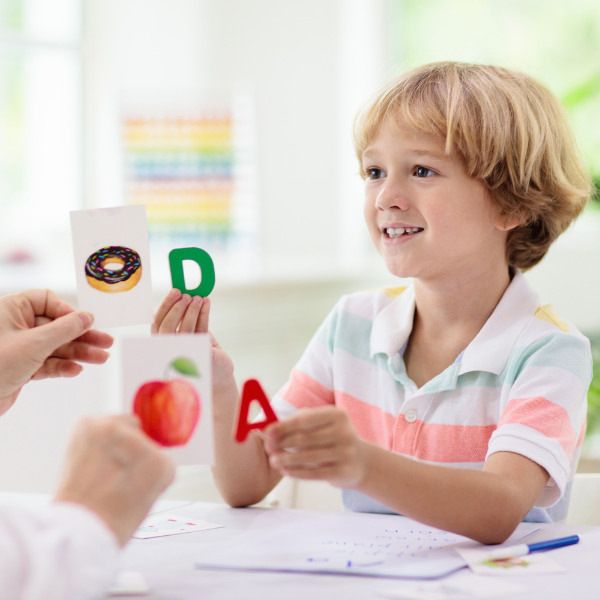
Children are naturally curious and learn in many ways: through play, listening, touching… but one of the most effective methods is visual learning .
Images, colors, diagrams, and posters stimulate children's memory and facilitate comprehension. But why is visual learning so powerful? And how can it be integrated into children's daily lives? Discover in this article the advantages of this method and how to use it to promote your child's learning.
1. What is visual learning?
Visual learning is based on the idea that children retain information better when it is presented in the form of images, graphics, videos, or colors .
📌 The most common media:
✔ Educational posters (alphabet, numbers, animals, world maps)
✔ Diagrams and mind maps to organize ideas
✔ Colorful flashcards for memorizing vocabulary
✔ Educational videos with animations
💡 Interesting fact : According to a Harvard University study, 65% of children are visual learners and retain information better through images than through reading alone.
2. Why is visual learning so effective?
2.1 It stimulates memory and information retention
🧠 The brain processes an image 60,000 times faster than text. A child will therefore more easily remember a letter illustrated with an animal than a simple black text on white.
2.2 It captures and maintains children's attention
🎨 Bright colors, playful designs and graphic representations make learning more attractive.
2.3 It promotes the rapid understanding of concepts
📊 A child will understand fractions faster with a visual diagram than with a complex written explanation.
2.4 It is suitable for children with special needs
👦 Children with dyslexia or attention deficit disorders particularly benefit from this method, as it simplifies access to information.
💡 Tip : Associating a word with an image improves young children's comprehension and reinforces their vocabulary learning.
3. How to integrate visual learning at home?
It is easy to integrate educational visual elements into children's daily lives.
3.1 Use educational posters in their room
📌 A poster of the alphabet , colored numbers or a world map helps children to assimilate concepts naturally .
💡 Where to place them?
✔ Near the desk or play area
✔ Above the bed for passive learning
✔ In the bathroom (posters of the days of the week, emotions)
3.2 Playing with illustrated flashcards
📖 Use visual cards to learn vocabulary, colors, shapes, etc.
✔ Match each word to an image
✔ Play in a quick and fun quiz format
3.3 Watch educational and interactive videos
🎥 Animated and interactive videos help to better understand certain concepts (science, mathematics, foreign languages).
3.4 Use visual educational games
🎨 Memory games with pictures , educational puzzles, educational coloring pages… anything that involves playful learning is effective!
💡 Concrete example : A world map puzzle allows the child to learn geography by manipulating the continents and countries .
4. The advantages of personalized educational posters
Educational posters are an excellent visual learning tool and offer several benefits:
✔ Constant learning : The child sees the information every day.
✔ Easily adaptable : You can choose posters according to your child's age and interests.
✔ Customizable : A poster with his name and favorite colors makes him more engaged.
💡 On Nookido.com , we offer personalized educational posters to make learning unique and fun for every child.
FAQ – Frequently Asked Questions from Parents
At what age is visual learning effective?
From 6 months old , babies begin to recognize shapes and colors . From 2 years old , they can use educational posters and flashcards .
Is visual learning suitable for children with learning disabilities?
Yes! It is particularly effective for children with dyslexia or attention deficit disorder because it facilitates the understanding of information.
Should other learning methods be replaced by visual learning?
No, the ideal is to combine several methods (listening, manipulation, reading) for a complete approach adapted to each child.
Key takeaways
Visual learning is a powerful and natural method that facilitates memorization, captures attention, and improves understanding of concepts.
🌟 Consider personalized educational posters to enrich your child's learning environment! Discover our designs on Nookido.com .





Share and get 15% off!
Simply share this product on one of the following social networks and you will unlock 15% off!